
Resources
Why Are 40% of Americans Jobless—No Matter the State of the Economy?
Whether the labor market is booming or struggling, tens of millions of Americans remain jobless or underemployed—trapped in a system that penalizes hiring while rewarding consumption and waste. Get America Working proposes a bold solution: shifting the tax burden off employment and onto pollution, resource depletion, and waste. This game-changing approach could create over 40 million full-time jobs without raising the deficit. Want to know how? Read the GAW position paper and explore the strategy that could transform the economy and unlock opportunity for millions.
Voters Were Right About the Economy. The Data Was Wrong.
In his Politico column "Voters Were Right About the Economy. The Data Was Wrong," our colleague Gene Ludwig, former US Comptroller of the Currency and Chair of the Ludwig Institute for Shared Economic Prosperity, explains some of the surprising reasons why the true extent of joblessness in the US isn't reflected by official unemployment statistics. His analysis tracks with ours -- GAW! has long argued the mass joblessness is an order of magnitude higher than the official unemployment numbers would indicate, and that this has been true for many decades.
"Near-record low unemployment figures — the figure was a mere 4.2 percent in November — counted homeless people doing occasional work as 'employed,'" Ludwig writes. "But the implications are powerful. If you filter the statistic to include unemployed people who can’t find anything but part-time work or who make a poverty wage (roughly $25,000), the percentage is actually 23.7 percent."
Read the full piece here. For more on the true extent of mass joblessness and how tax shifting can address it, read the GAW working paper here.
Why Conservatives Should Support a Pro-Growth, Revenue-Neutral Carbon Tax to Lower the Social Security Payroll Tax Rate
Jason J. Fichtner, Johns Hopkins University
This paper lays out the case for adopting a revenue-neutral carbon tax. Whether this growing interest is based on environmental concerns, desires for new revenue sources, or dissatisfaction with inefficient regulation, it is paramount that any policy targeting carbon emissions be designed to improve economic efficiency.
A properly designed carbon tax system would not only reduce carbon emissions, but also promote economic growth while minimizing the burden borne by those disproportionally affected.
This paper lays out the case for adopting a revenue-neutral carbon tax in which resulting revenue could be used to reduce the payroll tax rate; finance innovative private savings accounts on top of Social Security; finance other targeted pro-growth Social Security reforms; or shore up the Social Security system by devoting the revenue to the Trust Funds.
Chronic Mass Joblessness Is 10X Worse than Episodic Recession Job Loss
Whether official unemployment numbers are low (below 5%) or high (above 10%), they are dwarfed by chronic, hidden mass joblessness, which is generally an order of magnitude higher than official unemployment.
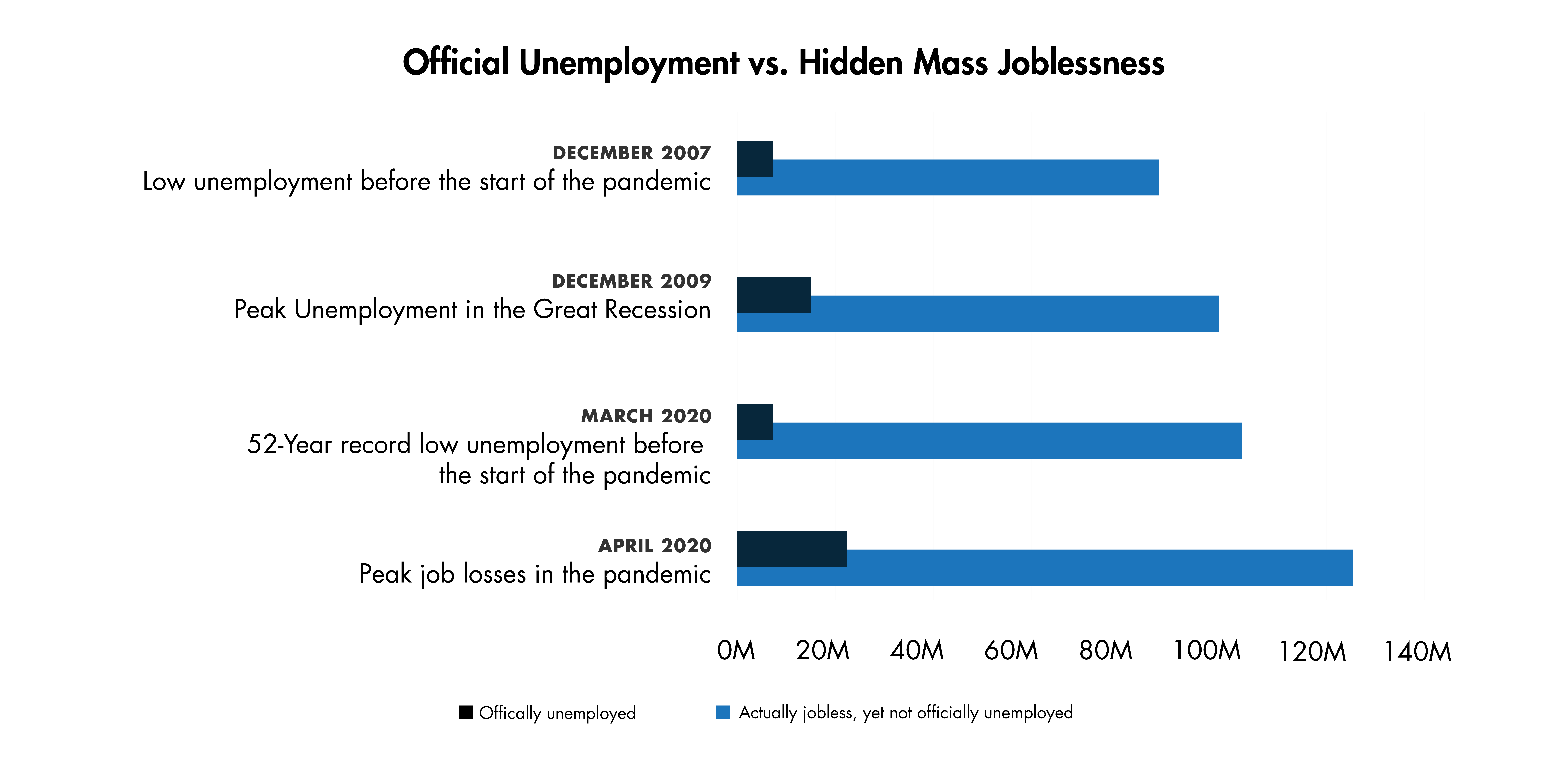
Long before the Great Recession or covid-19, the U.S. labor market suffered and continues to suffer from hidden, unofficial mass joblessness many times worse than peak official unemployment in a crisis, as the charts above show.